Most of this work happens before the concrete arrives or is invisible once it has set, which is why it is so hard to judge a quote from the kerb. The NZ Master Concrete Placers Association publishes a Code of Practice for Concrete Placement of Domestic Driveways setting out what a competent job involves. The clause references below come from it.
Before the truck arrives
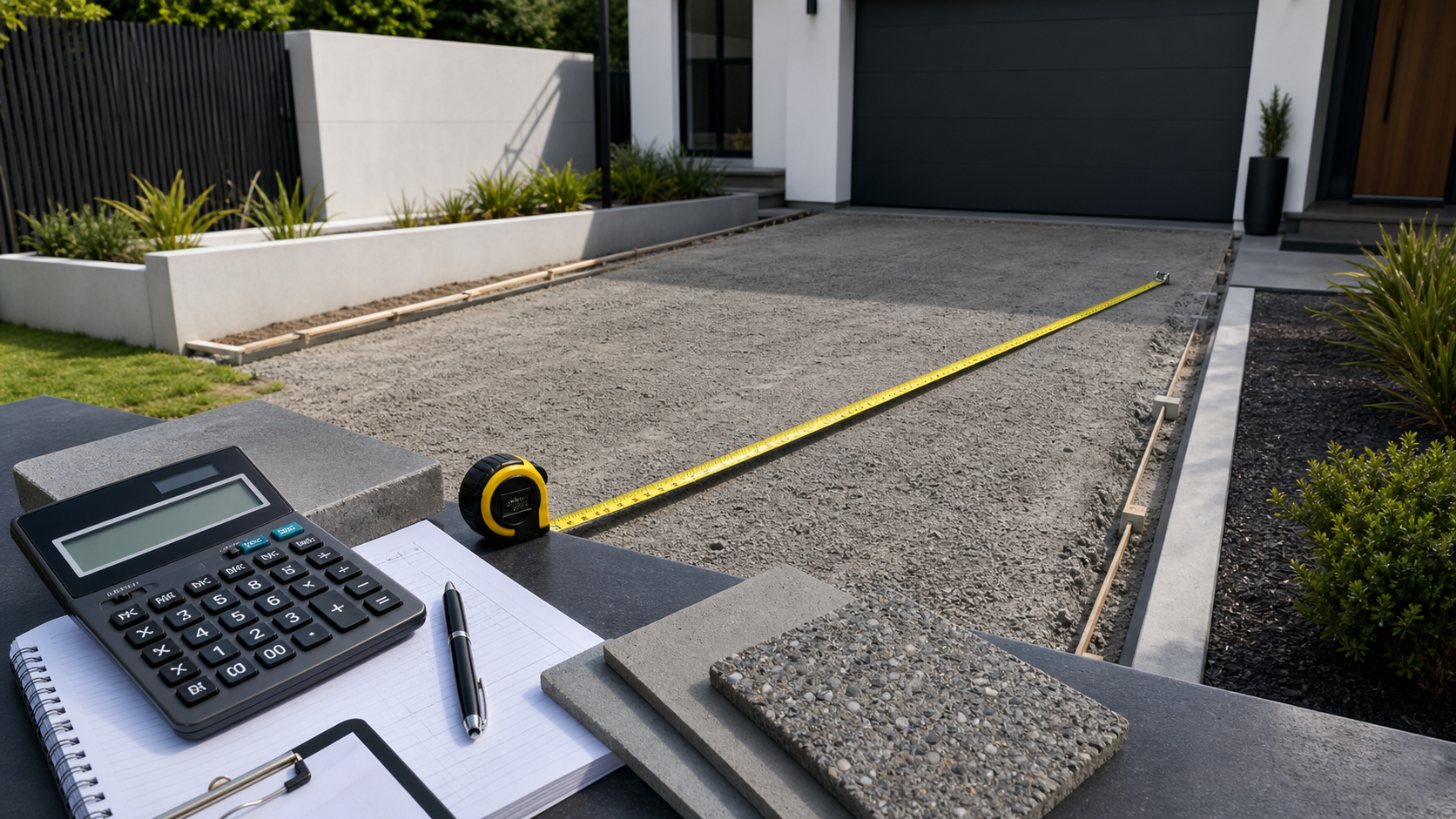
The sub-base is where most driveways are won or lost. Soils, vegetation and weak material get stripped out and replaced with 100 mm of Gap 20 or similar, placed and consolidated (cl. 1.2). Formwork is set to a minimum fall of 1:100, or 10 mm of drop per metre, so water runs off rather than sitting on the slab (cl. 2.2, 3.3).
Steel mesh, 665 or 668, goes in with sheets overlapped and tied, internal corners reinforced, and the sheets within the top third of the finished slab on chairs that suit the thickness (cl. 5.1–5.3). Mesh dumped on the subgrade and pulled up with a hook as the concrete goes in is not the same job, and you cannot tell from the surface. One point is widely misunderstood: mesh does not increase load capacity. It is crack control, and thickness and base preparation carry the load.
| Use | Slab thickness | Notes |
|---|
| Standard residential driveway | 100 mm minimum (cl. 2.1) | The floor, not a target |
| Campervan, boat, trailer, light truck | 125–150 mm | Should be itemised as a variation |
| Trucks and heavy vehicles | Specifically designed slab | Requires engineering input |
Concrete strength should be 20 MPa or stronger (cl. 2.2), and hand joints get marked out on the formwork before the concrete is confirmed (cl. 5.1).
On the day
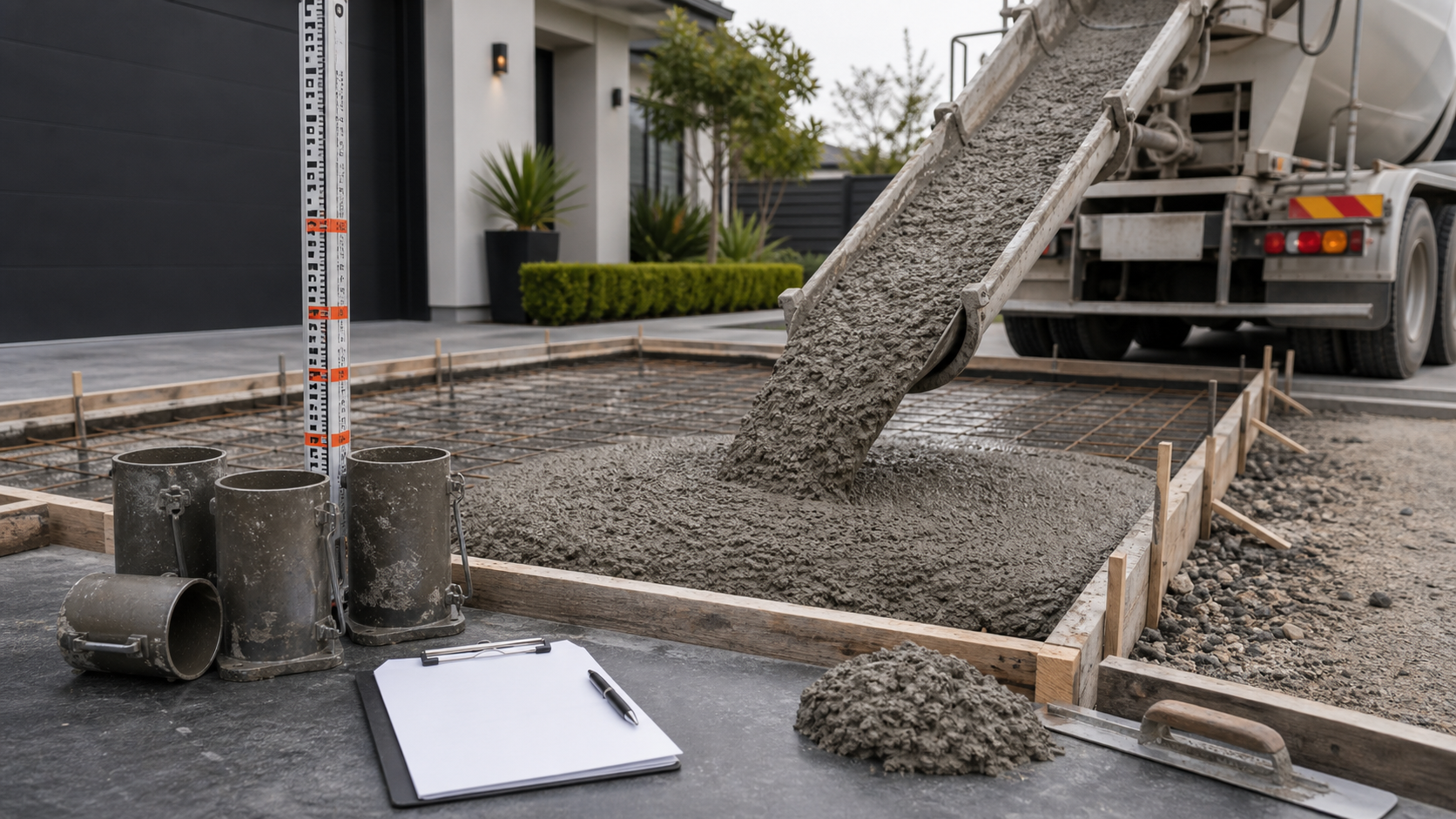
Concrete gets placed, then compacted. The code is blunt: all concrete must be vibrated (cl. 3.4.1–3.4.3), by immersion vibrator, vibrating screed, or a float with a mini-vibrator fitted. Compaction drives out trapped air so the slab reaches its designed strength. It is a requirement, not an upgrade, and it is the line most often missing from a cheap quote.
The crew screeds to a surface tolerance of ±10 mm from an established datum, string lined in several directions (cl. 2.1–2.2), bull floats, then applies the finish you specified.
Watch the water. NZS 3104:2003 allows only 10 litres per m³ to be added on site (cl. 2.3). A crew running a hose into the mix to make it easier to work is trading your slab's strength for their own afternoon. Where a pump is used, larger machines handle 19 mm stone, which means less shrinkage than a mix cut down to suit a smaller pump (cl. 3.2).
After the pour
An evaporation retarder goes on where conditions call for it, and the slab is protected from pets and people for the first 12–24 hours (cl. 4.4). One set of cat prints is permanent.
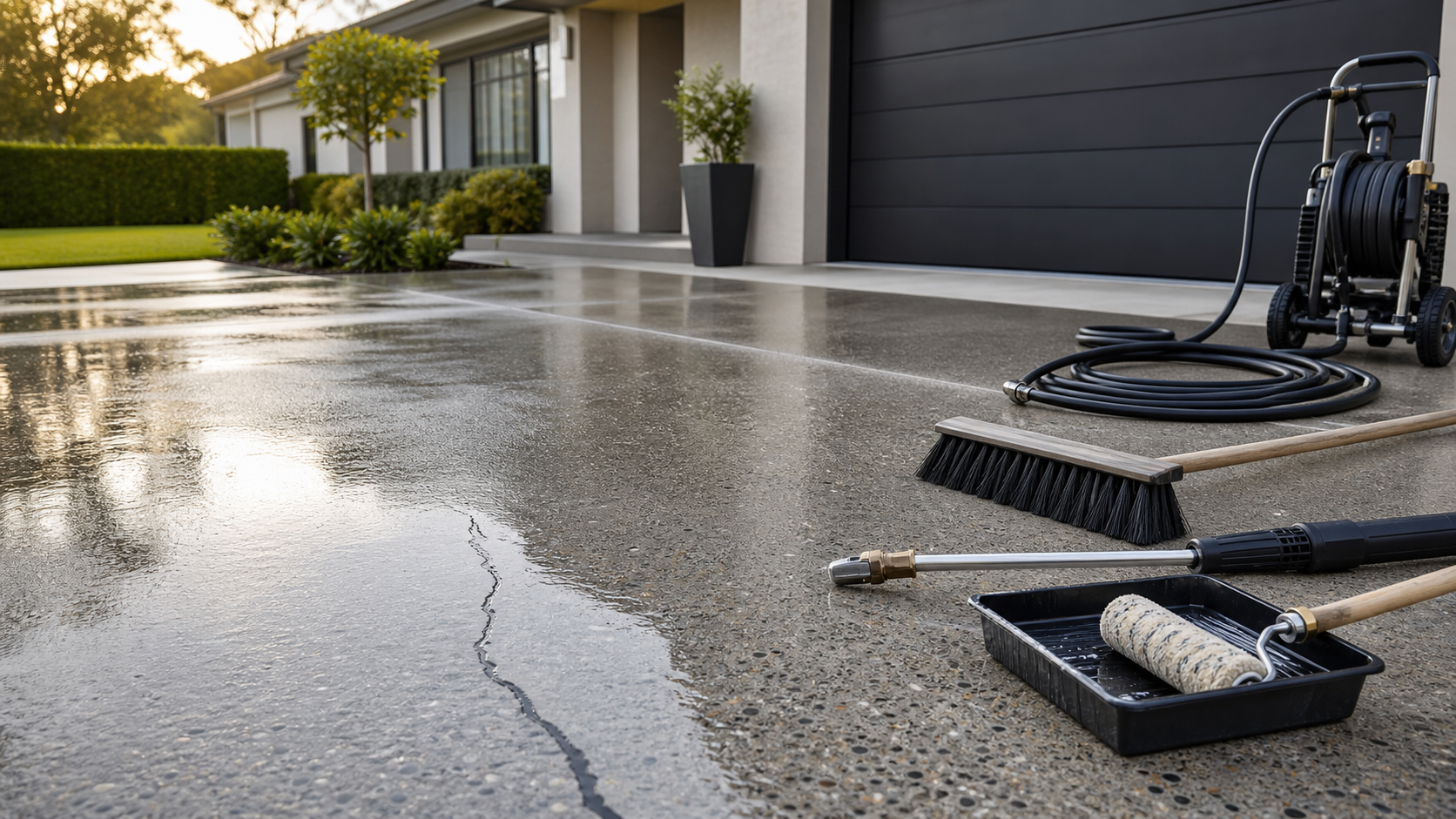
Control joints are saw cut 24–48 hours after placing, at 3 m centres, to a quarter of the slab thickness (cl. 5.2). Cut too late and the slab has already chosen its own cracks; cut too shallow and the joint does nothing.
Curing gets skipped most often, because it costs days rather than dollars. The code calls for constant water curing for a minimum of four days (96 hours), or another recommended method (cl. 4.3). It sits alongside NZS 3104:2003, NZS 3114:1987 for surface finishes and NZS 3109:1997 for construction, with CCANZ Information Bulletin IB80 covering residential driveways and paths.
What the code says will still happen
The code is usefully honest about the limits of the material.
- Concrete can crack. The code states it is not possible to guarantee the absence of cracking, regardless of the processes and placing systems used.
- Colour consistency, surface texture and flatness vary across a slab, and those variances are not grounds for rejection.
- Colour swatches and samples are indicative only.
- Hard trowelling gives a smooth surface that is slippery outdoors, which is why driveways get a broom or sponge finish.
Any contractor promising a driveway that will never crack is promising something the industry's own code says cannot be promised.