Costs & Pricing

How Much Does It Cost to Concrete a Driveway in NZ? (2026 Price Guide)

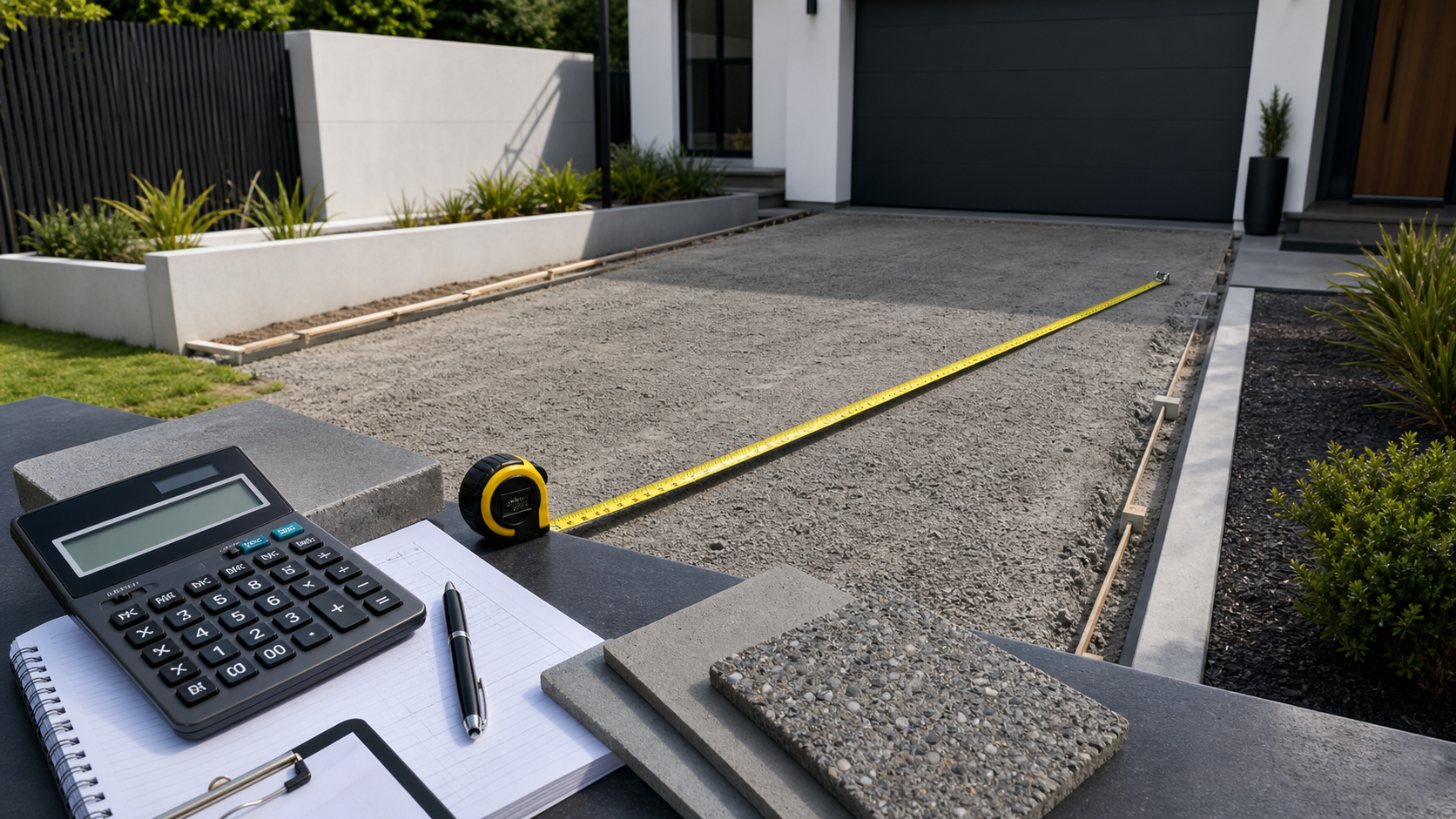
Driveway cost planning scene with measuring tape, calculator, and concrete samples

A plain broom-finish concrete driveway in Auckland costs roughly $90–$160 per square metre, supplied and laid. For a standard single driveway of about 20 m², that is $1,800–$3,200. For a double of about 40 m², it is $3,600–$6,400.

Every figure in this article includes GST. That one sentence is worth more than it looks, because most price guides never say which way they are quoting, and the difference is 15% of your total.

What follows is not another list of things that affect the price. It is the arithmetic: how much to concrete a driveway in NZ comes to once you have measured your own, how that changes across three finishes, and what the per-square-metre rate quietly leaves out. Ranges are a starting point for a budget, and a site visit is what turns a range into a number.

What does it cost to concrete a driveway in NZ right now?

Rates vary by finish more than by anything else you can choose. These are the Auckland bands as at September 2026.

FinishRate per m²What moves it within the band
Plain broom finish$90–$160Access, base depth, slab thickness, job size
Exposed aggregate$150–$250Stone choice, wash or polish, sealing
Stamped or patterned$150–$280Pattern complexity, number of colours, release and sealing

Coloured concrete sits inside the same decorative band as exposed aggregate. Basis for all three rows: supply and lay on a flat, accessible Auckland site, GST included, excluding earthworks, spoil removal, drainage and the vehicle crossing.

The bands are wide because two driveways of the same size can be very different jobs. A flat site in Papatoetoe with a truck able to back up to the pour sits near the bottom. A sloping section with a wheelbarrow run and a skip full of old concrete sits near the top. If you want the reasoning behind each variable in detail, we have written it up separately in the factors that drive concrete driveway cost.

A note on GST, because almost nobody states it

Trade quotes are usually written plus GST. Consumer price guides usually quote including GST. Same job, 15% apart.

A quote of $9,000 plus GST is $10,350 to pay. Put next to a rival quote of $9,800 including GST, the cheaper-looking one is actually the dearer one. Check the bottom of every quote before you compare anything above it, and if the basis is not written down, ask.

This article works GST inclusive throughout. Where a figure has been taken from a trade source that quotes plus GST, it has been converted and labelled.

How to measure your driveway before you read the prices

Length times width, in metres. Walk it with a tape and write down both numbers.

Then add the bits people forget. Add the flare where the driveway widens towards the road. Add any turning bay, parking apron or path you want poured at the same time. Leave the vehicle crossing out of your measurement, because it is a separate job priced separately, for reasons covered below.

A driveway 3.2 m wide running 12 m from the footpath to the garage is 38 m², so read the 40 m² row in the next table.

If you would rather not get the tape out:

  • One car wide, house close to the street: about 20 m²
  • Double width, or a single with a turning area: about 40 m²
  • Long, rear site, or shared access: 80 m² and up
  • Sloping sections in areas like Titirangi often need more concrete than the flat measurement suggests, once steps, retaining and turning space are allowed for

Take your number to the table below.

Concrete driveway cost by size and finish

This is the table most price guides stop short of. Find your size, then your finish, and read the total.

DrivewayAreaPlain broomExposed aggregateStamped
Single20 m²$1,800–$3,200$3,000–$5,000$3,000–$5,600
Double40 m²$3,600–$6,400$6,000–$10,000$6,000–$11,200
Long or shared80 m²$7,200–$12,800$12,000–$20,000$12,000–$22,400

Assumptions behind every figure in that table:

  • GST included
  • A flat, accessible Auckland site with a truck able to reach the pour
  • A 100 mm slab on a prepared, compacted base
  • Excludes earthworks, spoil removal, drainage and the vehicle crossing
  • Confirmed by a site visit, not by a table

Expect the top of your band if the site is tight, sloping, or the old slab has to come out first. Expect the bottom if the ground is sound, the truck can get close, and the job is straightforward.

At 20 m², small pours carry proportionally higher fixed costs. Mobilisation, formwork and a part-load of concrete cost much the same on 20 m² as on 40 m², so the effective rate sits nearer the top of the band. If the truck is coming anyway, adding a path or a patio to the same pour is the cheapest concrete you will ever buy.

At 40 m², you are in the most common residential job in Auckland and the sweet spot on rate. It is big enough to spread the fixed costs and small enough to finish in one pour. This is also where finish choice starts to cost real money, which is why it pays to look at how stamped concrete patterns are priced and sealed before you commit.

At 80 m², you are into long, shared and rear-site driveways. A shared access driveway usually brings extra approvals and written agreement from the other owners involved. A driveway that will carry a truck, a horse float or a heavy campervan needs a thicker, designed slab of 125–150 mm rather than 100 mm, and that lifts the rate above the bands shown here.

What the per-square-metre rate does not include

The gap between a $3,600 surface and a $9,000 invoice is almost always in this table.

Line itemWhen it appliesHow it is usually charged
Breaking out the old drivewayReplacement jobsPer m² or as a lump sum, plus tip fees
Excavation and spoil removalAlmost all jobsBy the truckload, and Auckland clay is heavy and wet
Extra hardfill over soft groundClay or filled sitesBy the tonne, or per m² of extra depth
Drainage, sumps and channel drainsWhere water has nowhere to goPer item
The vehicle crossingAny new or altered crossingQuoted separately, with a separate approval
Concrete pumpWhere the truck cannot reach the pourHire plus a minimum pour volume
Thicker slab for a campervan, boat or truckHeavy vehicle loadingExtra concrete plus heavier mesh

We have deliberately not put a dollar figure against pump hire or the vehicle crossing. Both vary too widely by site for a published range to be any use to you, and a made-up number is worse than none. Insist that both are itemised in writing on your quote instead.

The vehicle crossing is a separate job with a separate approval

The vehicle crossing is the section between the kerb and your boundary, and it is not the same job as your driveway.

Auckland Transport approves the vehicle crossing, and written approval is required before any work on it starts. Auckland Council administers the Auckland Unitary Plan, whose Chapter E27 sets the rules for vehicle access, widths and gradients, and Council is also who a resource consent or building consent goes to where one is needed.

Two bodies, two processes. Approval from one does not cover the other, and a contractor who tells you otherwise has not done many crossings.

Auckland does two things to driveway budgets on top of that. Clay through much of the south and west, in suburbs like Papakura and Henderson, means more excavation and more hardfill before any concrete is poured, and it holds water, so drainage is rarely optional. Sloping sections in the Waitākere foothills add retaining, steps and access difficulty, and coastal North Shore sites around Takapuna add exposure that makes sealing and finish choice matter more.

For a free on-site quote anywhere in Auckland, call 09 977 9966.

Why two quotes for the same driveway differ by thousands

You have three quotes on the kitchen table and a $5,000 spread between them. The money is hiding in one of these seven places.

  • GST. One quoted plus, one quoted including. That alone is 15% of the total.
  • Slab thickness. 100 mm against 125 mm is 25% more concrete over the same footprint.
  • Base depth. A quote that does not name a base depth has probably not allowed for much of one.
  • Mesh specification and placement. Which mesh, and where in the slab it will sit.
  • Spoil. Is removal and the tip fee included, or will it arrive later as a variation?
  • The vehicle crossing. In or out. This is the single biggest swing item on the list.
  • Contingency. A quote with no allowance for the unknown is not cheaper, it is less finished.

The fix is simple and almost nobody does it. Write down one specification, covering area, slab thickness, finish, base depth and mesh, and send the same document to all three contractors. Ask every one of them to quote GST inclusive with the crossing itemised separately. Without that, you are not comparing quotes, you are comparing assumptions.

What a fair rate should buy you

The New Zealand Master Concrete Placers Association publishes a Code of Practice for Concrete Placement of Domestic Driveways. It is the document your quote should be measured against, and the numbers in it are not negotiable in the way finishes are.

ItemWhat the code calls for
BaseWeak material removed, replaced with 100 mm of Gap 20 or similar, placed and compacted
Slab thickness100 mm minimum, more where trucks or heavy vehicles will use it
Concrete strength20 MPa or stronger
Steel mesh665 or 668, sheets lapped and tied, sitting in the top third of the slab
Fall1:100 minimum, or 10 mm per metre
CompactionAll concrete must be vibrated
Control jointsCut 24–48 hours after placing, at 3 m centres, a quarter of the slab depth
CuringWater cured for a minimum of four days
Surface toleranceWithin ±10 mm of the established datum

Now the part most contractors would rather not put in writing. The code itself is clear that concrete can crack, and that no placer can guarantee the absence of cracking regardless of the systems used. Steel mesh controls cracking, it does not increase the load capacity of the slab. Colour, surface texture and flatness will vary across a pour, and colour samples are indicative only. A hard-trowelled finish looks superb and is genuinely slippery outdoors, which is why driveways get a broom or an exposed finish instead.

Anyone wanting to go further can read NZS 3104 on concrete production and CCANZ Information Bulletin IB80 on residential concrete driveways and paths.

When a cheap quote is a warning sign

Do the arithmetic before you accept the lowest number.

Ready-mix concrete is typically quoted at around $160–$250 per cubic metre plus GST for supply, or $200–$300 per cubic metre with a contractor to place it. A 40 m² driveway at 100 mm is about 4 m³ before any allowance for wastage or thickened edges. Converted to a GST-inclusive basis, the raw concrete alone is roughly $740–$1,150 before a single hour of labour, any hardfill, mesh, formwork, spoil removal or finishing. The detail behind those supply rates is in our guide to concrete prices per cubic metre in NZ.

Set that against a finished-driveway quote well under $90/m² and the sums stop working. A rate that low is not a bargain, it is a signal that something in the specification is missing. Usually it is the base depth, the slab thickness, or the mesh, and all three are invisible the day the job finishes and obvious four winters later.

Budgeting a real Auckland driveway

Here is one job costed end to end. A 40 m² double in Henderson, plain broom finish, replacing a cracked slab that has lifted at the joints.

  • Surface at $90–$160/m²: $3,600–$6,400
  • Breaking out and carting away the old slab, plus extra hardfill over clay: quoted separately, and usually the difference between the bottom and the top of a real quote
  • Contingency at 10%: the ground is the one thing nobody can see until the digger arrives
  • All-up realistic range: $5,300–$9,200, an effective rate of about $130–$230/m² once everything is counted

The point is worth saying plainly, because no rate table says it. The headline per-square-metre rate buys the surface, not the job. A homeowner who budgets on the headline rate is the homeowner who feels misled when the quote lands. Budget on the all-up figure, then let a site visit sharpen it. Our full Auckland cost, design and installation guide walks through the same decisions from the design side.

Frequently asked questions

How much does a 40 m² concrete driveway cost in NZ?

Roughly $3,600–$6,400 for a plain broom finish, or $6,000–$11,200 for exposed aggregate or stamped concrete, GST included. Those figures cover supply and lay on a flat, accessible site. Site costs such as spoil removal, extra hardfill and the vehicle crossing are quoted on top.

How much is concrete per square metre in NZ?

For a finished driveway in Auckland, expect $90–$160/m² for a plain broom finish, $150–$250/m² for exposed aggregate and $150–$280/m² for stamped or patterned concrete, all GST inclusive. Raw ready-mix supply is a different figure again, at around $160–$250 per cubic metre plus GST.

Are concrete driveway prices plus GST or including GST?

Both are used, which is why quotes are so hard to compare. Trade quotes are usually written plus GST and consumer guides usually quote inclusive. Multiply a plus-GST figure by 1.15 to compare it against an inclusive one. Every price in this article includes GST.

Is exposed aggregate more expensive than plain concrete?

Yes. Exposed aggregate runs about $150–$250/m² against $90–$160/m² for a plain broom finish, GST included. The extra pays for the decorative stone, the wash-off or polish, the additional labour on the day, and sealing. Stone choice moves the number more than the size of the driveway does.

How thick should a concrete driveway be in NZ?

The NZ Master Concrete Placers Association code sets a 100 mm minimum for a domestic driveway on a compacted 100 mm base, in 20 MPa or stronger concrete. If a truck, horse float or heavy campervan will use it, you want a designed slab of 125–150 mm, and that thickness should be itemised in your quote.

Do I need approval for a concrete driveway in Auckland?

For the vehicle crossing between the kerb and your boundary, yes. Auckland Transport approves it and written approval is required before work starts. Auckland Council administers the Auckland Unitary Plan, whose Chapter E27 covers vehicle access, and Council handles any resource or building consent. They are two separate processes.

How much should I allow on top of the quoted rate?

Add about 10% as contingency for ground conditions nobody can see until excavation starts. On top of that, budget separately for spoil removal, any extra hardfill, drainage, and the vehicle crossing if you are altering one, since none of those sit inside a per-square-metre rate.
What to do next

Measure the area with a tape, including the flare at the road and any turning bay. Decide on the finish. Write down a single specification covering area, slab thickness, base depth, mesh and finish, then send that same document to three contractors and ask each of them to quote GST inclusive with the crossing itemised separately. Compare the specifications first and the totals second.

If you are ready to put real numbers against your own driveway, we can measure it, check the ground and the access, and price driveway installation properly.

For a free on-site quote anywhere in Auckland, call 09 977 9966.

Ready to start your Auckland concrete project?

Contact Auckland Concrete Driveways for a free on-site quote. We cover central Auckland, North Shore, West Auckland, and South Auckland.